Slitting Saw Speeds & Feeds
Carbide slitting saws — RPM, feed, chip load & depth from RobbJack's data.
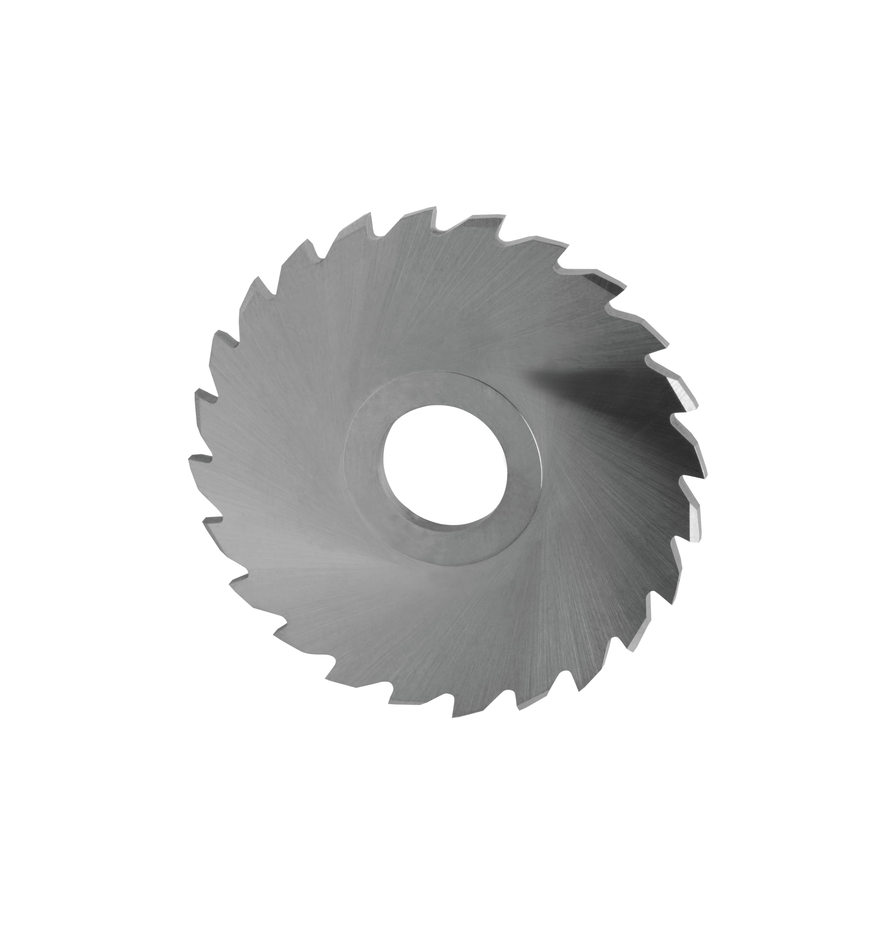
Material
Operation
Your machine
Machine-awareEvery recommendation is clamped to these limits — the numbers you see are numbers your spindle can actually run.
Compatible arbors · max depth of cut
0.75″ saw · 0.25″ bore
| Arbor | Max DOC | At 0.5″ deep |
|---|---|---|
| SA-ER16-L-08·SA-ER16-S-08·SA-ER20-L-08·SA-ER20-S-08 | 0.1375″ | ✗ Too deep |
| AB-250 | 0.075″ | ✗ Too deep |
| NAB-250·NAB-250-TCThru-coolant | 0.04″ | ✗ Too deep |
Max DOC = (saw Ø − arbor flange) ÷ 2, less a .050″ clearance cushion. Click an arbor for its full page.
Your total depth of 0.5″ exceeds every compatible arbor's clearance — step up to a larger saw diameter or reduce the slot depth.
Spindle Speed
12,000
RPM · 100% of nominal
Feed Rate
24.0
IPM
Surface Speed
2,358 SFM
Chip Load / Tooth
0.00020 in
80% chip load
Slot Width (WOC)
0.0120 in
Depth of Cut / pass
0.0480 in
Metal Removal Rate
0.014 in³/min
Spindle Power
0.007 HP
Read before you run
Recommendations are computed starting points based on typical conditions — not guarantees of performance, tool life, or fitness for your application. Machining involves inherent risk: you are solely responsible for safe operation, for verifying every parameter against your machine, spindle, arbor, workholding, and guarding limits, and for proving all parameters on a test cut before production. RobbJack Corporation assumes no liability for tool breakage, machine damage, scrapped parts, production loss, or personal injury arising from use of these recommendations. By using this calculator you accept RobbJack's Terms & Conditions.
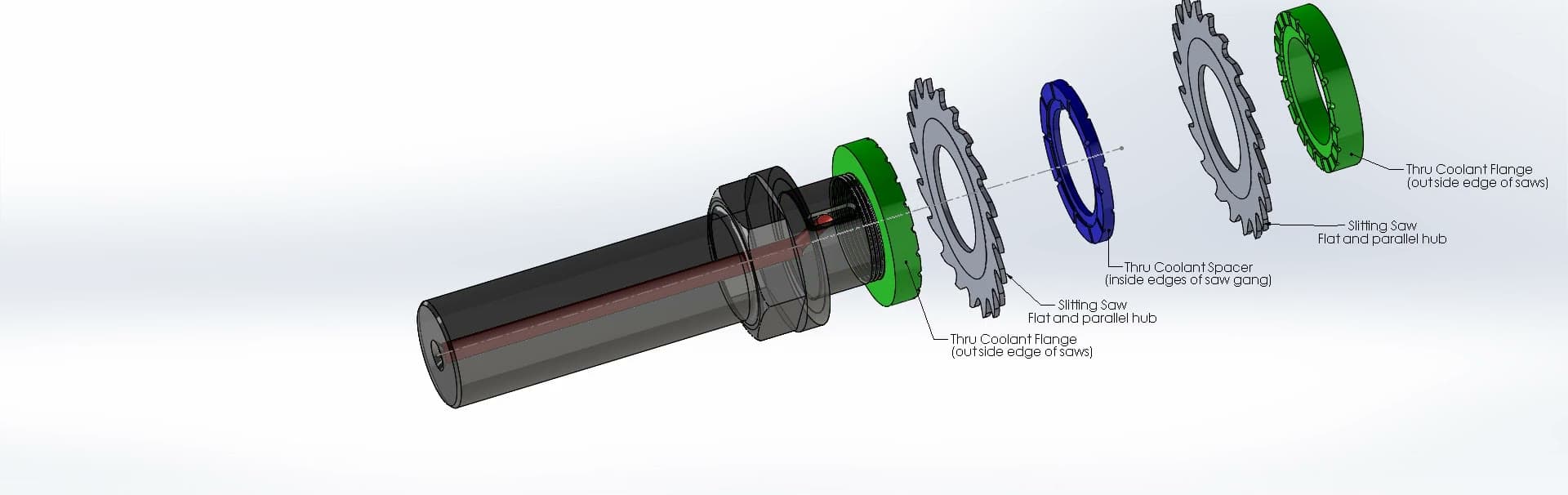
Thru-Coolant NAB Precision Saw Arbor
Slitting saws fail when coolant can't reach the cut — external flood gets blocked by fixturing and part geometry. The NAB arbor delivers coolant through the center and out through thru-coolant flanges onto both faces of every saw— equal pressure, right where the cut happens. Precision-ground to 25 millionths and grips the saw up to 15× more tightly — so it can't slip or spin on the arbor — for faster speeds & feeds, no walking, and far longer tool life.
- 0.000025″
- tolerance — 25 millionths
- 15×
- grip on the saw vs. a typical arbor
- ≈80%
- fewer causes of saw failure
- ↑ S&F
- faster speeds & feeds, longer life
Recommended for your 0.25″ bore saw
Thru-Coolant Arbor
Precision Rigid Saw Arbor made for saws with a 0.250-in ID, 0.5-in Shank Diameter, 0.570-in Flange Diameter, 2.2-in Shank & Flange Length, Thru Coolant
Add to quote →Carbide Thru-Coolant Flange · recommended, sold in pairs
Solid Carbide Thru Coolant Flange, 0.570in Outside Diameter, 0.060in Thickness, 0.250in Inside Diamter with 10 Coolant Ports (Sold in pairs)
Add to quote →-TC arbors include steel thru-coolant outer flanges and steel spacers. Solid carbide flanges and spacers are recommended to eliminate burrs and potential issues — carbide lasts a lifetime and never scratches the saw. Add thru-coolant spacers to gang multiple saws.
Email me this setup sheet
We'll email these exact recommendations to your inbox so you can save, print, and share them. No obligation.
CAD / CAM tool libraries
These same tested numbers, already in your CAM — download the RobbJack tool library with per-material cutting presets on nearly every tool.
Starting speeds & feeds by material
Tested starting SFM, RPM, feed, and chip load by diameter — pick your material, then fine-tune in the calculator.
How the calculator works
This isn't a generic chip-load chart. It starts from RobbJack's 67 years of tested machining data for the actual tool, picks a safe and productive starting point, and keeps every recommendation inside your machine's limits. The numbers are deliberately conservative — many shops run faster once the process is dialed in.
See the logic in action
What each control does
Material & grade — the starting point
It picks the tool, not just the numbers
Cut & strategy — slot vs. profile, conventional vs. trochoidal
Setup rigidity — be honest about your fixture
Total depth of cut — split into passes for you
Machine limits & the power safety net
Reading your results
You get a roughing and a finishing card (wall and floor passes for hardened die/mold grades). The percentages next to RPM and chip load show how much room is left before the tool's tested limit.
- Spindle Speed (RPM)
- With “% of nominal” — how hard the recommendation pushes versus the tool's tested ceiling.
- Feed Rate (IPM / mm·min)
- Table feed for the recommended RPM and chip load.
- Surface Speed (SFM / m·min)
- Cutting speed at the edge — set by the material.
- Chip Load / Tooth
- With “% chip load” — feed per tooth versus the tested limit.
- Width of Cut (WOC) / Slot Width
- Radial engagement for the chosen cut and strategy.
- Depth of Cut / pass (DOC)
- Axial depth per pass after the power and geometry checks.
- Metal Removal Rate
- Material removed per minute — the productivity number.
- Spindle Power (HP / kW)
- Estimated load, kept inside your headroom.
Slitting saws
Switch to the Slitting Saw tab and enter outside diameter, arbor bore, and blade thickness. The engine picks the blade — stepping up to a K-Series for deep cuts — sets the tooth count and chip load by material, enforces a safe maximum depth of cut, and matches a thru-coolant NAB arbor to your bore. New to saw setup? Read the slitting-saw setup guide.
A starting point, not a limit
Always verify on your machine, holder, and setup. Want them dialed in for you?
Tap & cut testing →